Event-contract ranking for binary-options traders: Polymarket ranks first overall; Kalshi has the lowest buy-then-sell loss
The dividing line across these five products is how a position can end. The first four can be sold or held to expiry; Binance Event can only wait for settlement after confirmation. This full report compares profit paths, executable costs, break-even hurdles, scoring evidence, and participation risk.
Overall ranking: ① Polymarket (96.8), ② Kalshi (94.9), ③ Binance Wallet / Predict.fun (88.7), ④ OKX (80), ⑤ Binance Event (70). This is not a win-probability ranking; Kalshi has the lowest loss when considering only an immediate sale after entry.
The dividing line is how a position can be exited. After entry, OKX, Polymarket, Kalshi, and Wallet / Predict.fun positions can be sold or held to expiry; Binance Event must await settlement once confirmed. That difference determines how prices should be read, where profit can come from, and which costs are directly comparable.
1 · Start with profit and loss: two product families, two paths
Same core trading family × 4
Order-book binary shares
OKXPolymarketKalshiBinance Wallet · Predict.fun
Like an exchange-traded binary option with early close: after buying shares, either sell to realize a price move or hold for the 1 / 0 settlement
Beyond the shared trading skeleton, the four products differ in scope, collateral, book implementation, settlement anchor, dispute governance, and fees.
Different product family × 1
Platform fixed payout
Binance Event
Like a familiar fixed-payout binary option: enter a Premium + accept the platform's payout ratio → hold to expiry
There is no maker/taker book and no early sale; after submission, the contract waits for a result based on two Price Index observations.
This comparison uses r=0.80, locked at confirmation
03Lock and hold
No repricing or early exit
04Index-based settlement
Correct call returns 1+r
Order-book products have two profit paths; Binance Event has only the second
Path 1 · Sell before expiry
Realize a rise in the share price
Buy C shares at Pbuy, then sell at Psell: net P&L=C×(Psell−Pbuy)−fees on both trades. For 100 shares moving from 0.40 to 0.72, profit before fees is 32; selling after a fall to 0.30 loses 10. The final outcome need not be correct, but a buyer must exist and the price move must cover spread, slippage, and both fees.
Do not confuse two kinds of “spread”: a directional trader profits from the change between entry and a later exit; the same-time bid-ask spread is usually a cost. Capturing that spread is primarily a market-making strategy that requires continuously quoting both sides.
Path 2 · Hold to expiry
Correct receives the fixed outcome; wrong goes to zero
Order-book shares: 100 shares bought at 0.40 cost 40. Correct pays 100 for a 60 profit before fees; wrong pays zero for a 40 loss. Binance Event: with Premium 100 and r=0.80 for the compared contract, correct returns 180 for an 80 profit, wrong returns zero for a 100 loss, and exact index equality refunds 100.
The four order-book products also support this path; only Binance Event lacks Path 1. “Event contract” is an umbrella label and does not mean every event contract forbids early sale.
How do these products relate to binary options?
Direct conclusion: if “binary option” means predicting direction and ending with only a correct or wrong result, all five products share the same binary-outcome economics. If it means accepting a platform's fixed payout and being unable to exit after confirmation, only Binance Event offers the same trading experience. OKX, Polymarket, Kalshi, and Wallet / Predict.fun turn the binary payoff at expiry into tradable shares.
Four order-book products
Binary payoff + tradable shares
Same: correct settles at 1, wrong at zero, with known maximum loss. Different: odds become share price P, traders and market makers set the price, and shares can be sold before settlement. For the trader: profit can come from the final result or an interim price move, but spread, slippage, and incomplete exit become risks.
Binance Event
Closest to a fixed-payout binary option
Same: choose Higher / Lower, accept platform-quoted r, lose the Premium when wrong, and know maximum profit and loss upfront. Different: exact index equality refunds the Premium. For the trader: there is no share price or early sale; confirmation means waiting for expiry.
Trader action
Order-book event contracts × 4
Binance Event
Conclusion for a binary-options trader
What do I see at entry?
A share price P, which is both cost per share and approximate market-implied probability
The Premium staked and platform-quoted net payout ratio r
Binance Event has the familiar entry flow; on order-book products, read “odds” as a tradable price.
Where can profit come from?
Two paths: sell after the price rises, or hold to expiry and receive 1 when correct
One path only: hold to expiry and earn A×r when correct
Order-book products add a price-movement profit path that a fixed-payout binary option lacks.
Can I leave when my view changes?
Yes, but exit price and full fill depend on live bids
No; confirmation means waiting for expiry
The book gives an exit right but not a good-price guarantee; Binance Event provides no exit right.
What hurdle must my edge beat?
Entry share price plus fees; an early sale must also cover spread, slippage, and exit fee
The hurdle implied by the platform payout ratio; at r=0.80, non-tie break-even is 55.56%
Neither product pays simply because accuracy exceeds 50%; the forecast must first clear its after-cost break-even hurdle.
This maps trading mechanics, not legal classifications: jurisdictions may use labels such as binary option, digital option, event contract, or prediction market differently. The CFTC baseline emphasizes binary cash settlement at expiry, while exchange binary options such as Nadex also allow early exit through an offsetting order.
Five short-horizon Up/Down products compared
This table compares only short-horizon products that ask whether BTC or another asset finishes Up or Down. It excludes politics, sports, Above, Hit, Between, scalar, combo, and other markets on these platforms. The first four trade binary shares and permit sale before settlement; Binance Event is a directional contract with a platform-quoted payout ratio that must be held to settlement after confirmation. Order-book-only metrics are marked N/A for Binance Event so all five products remain visible in the comparison.
Difference
OKX
Polymarket
Kalshi
Binance Wallet · Predict.fun
Binance Event
Player conclusion
Difference in one line
Offers five-minute markets and user-set prices, but the sampled book lacked enough liquidity for a 100-share round trip
Offers five-minute markets and onchain shares, ranking first overall; sampled round-trip cost was not the lowest
Had the lowest sampled 100-share cost and uses a regulated USD exchange structure; the shortest verified crypto market was 15 minutes
Provides Binance Wallet access to five-minute onchain markets; all six tests filled, but it had the highest round-trip cost among fillable products
The compared contract uses r=0.80, locked at confirmation; there is no share order book or early exit
Polymarket leads overall; Kalshi wins on sampled round-trip cost alone; Binance Event most closely matches a fixed-payout binary option.
Account and funds required
Uses a centralized OKX account and USDT; funds remain inside OKX and each winning share pays 1 USDT
Uses a self-custodied Polygon wallet and pUSD, which is supported by USDC; each winning share pays $1
Uses a Kalshi account and USD; contracts are listed and cleared through a regulated exchange structure, and each winner pays $1
Uses a Binance Wallet/Predict Prediction Account with USDT-backed funds on BSC; Predict.fun operates the market and Binance provides the gateway
Enter Premium A on the Binance Event page; the resulting platform contract is non-transferable and a correct call returns A×(1+r)
Stay with OKX, Kalshi, or Binance Event for a centralized account; consider Polymarket or Wallet / Predict.fun only if you can manage self-custody, networks, and stablecoins.
Orders and early exit
Buy against the live book or set a limit price; cancel unfilled quantity and sell filled shares back into the book
Buy against the live book or set a price; cancel unfilled quantity and sell before settlement, with final execution confirmed onchain
Use market or limit orders; cancel unfilled quantity and sell after entry, with the actual exit price determined by the live book
Trade through Predict.fun with market or limit orders; cancel unfilled quantity and sell after entry, with Binance Wallet providing the gateway
Users cannot quote a price and must accept the displayed r; after confirmation the contract cannot be cancelled or sold and must await expiry
The first four give you pricing and exit control; Binance Event does not. But permission to sell does not guarantee a full exit at a good price.
Comparable short horizons
5-min / 15-min / daily across BTC, ETH, and SOL
5-min / 15-min / hourly / daily; BTC and others
Market-specific durations; official product documentation includes a 15-minute BTC market
The current Predict.fun Crypto directory shows 5-min / 15-min / 1-hour / 1-day markets across BTC, ETH, and BNB; coverage is dynamic
Four durations are publicly documented; the shortest duration verified in this review was longer than five minutes
For five-minute play, the verified choices are OKX, Polymarket, and Wallet / Predict.fun; Kalshi's shortest verified market was 15 minutes, and no five-minute Binance Event was confirmed.
How short-horizon Up/Down is decided
Uses OKX's own index: the final 30-second average for five-minute markets and 60-second average for 15-minute markets; Up wins when the expiry average is at least the target
Uses a Chainlink-computed 30- or 60-second time-weighted average; the exact comparison and equality treatment come from that market's rules
The sampled BTC 15-minute market compares 60 one-second CF Benchmarks BRTI observations before open and expiry; Up/Yes wins when the expiry average is at least the opening average
Recurring short-horizon markets use Chainlink Data Streams to compare opening and closing values; the current five-minute rule pays 0.50 per share to both sides on exact equality
The next second fixes the opening Price Index; Higher wins above it at expiry, Lower wins below it, and equality refunds the Premium
None can be settled from the last chart trade alone; use that market's named index, sampling window, comparison rule, and tie treatment.
Can an ordinary user verify settlement?
Rules, the OKX index, opening and closing windows, final result, and review rules are visible
Chainlink TWAP values, timestamps, access to original signed reports, market rules, and final results are public
Market-specific rules, the CF Benchmarks BRTI source, and final results are public and recorded by the regulated exchange
The normal path puts signed Chainlink reports, opening and closing values, and results onchain; the paused-state emergency path is also disclosed in the rules
The Price Index, payout amount locked at confirmation, order, and settlement result are retained in account records
Rules and settlement records are checkable across all five, so this is not a major differentiator; exit rights and executable liquidity matter more to the player.
Not comparable: 0 / 6 completed; the constrained side had at most 80.5 shares
Second cheapest: 6 / 6 completed, median loss 1.6013 USDT
Cheapest: 6 / 6 completed, median loss 0.5665 USDT
Third: 6 / 6 completed, median loss 5.6620 USDT
N/A: there is no order book or early sale, so a 100-share immediate round trip cannot be tested; this comparison calculates the payout discount at r=0.80
Kalshi was cheapest in this sample, Polymarket second, and Wallet / Predict.fun third; OKX could not fully exit 100 shares, while Binance Event is not applicable.
Buy and hold to settlement: lowest break-even hurdle
Up break-even hurdle 94.7797%–94.9026%; Down could not fill 100 shares, making this the least favorable sample
Up 3.2037%–15.4199%; Down 88.7392%–98.1372%
Up 1.6035%–9.9074%, the lowest Up hurdle in all three snapshots; Down 91.3848%–98.6967%
Up 10.4269%–19.6723%; Down 85.3925%–95.2351%, the lowest Down hurdle in all three snapshots; the strict measure adds half the tie probability to the selected outcome probability
Compared contract at r=0.80: the non-tie hurdle is 55.56%; with tie probability t, the unconditional hurdle is q*=(1−t)/1.8
There is no fixed winner for holding to expiry: the hurdle changes with side and entry price. A lower hurdle means a cheaper entry, not an easier prediction.
Base fees across the four order-book products (as of August 30, 2026)
Base fees are only one part of trading cost. Final cost scores use the live two-sided books in section 3, including spread and depth impact. Rates can vary by category or series, so verify the specific market before trading.
Fee item
OKX
Polymarket
Kalshi
Binance Wallet · Predict.fun
Base taker-fee formula
0.045 × C × P × (1−P); 1.125 USDT per 100 shares at P=0.5; no settlement fee
Short-horizon crypto Up/Down: 0.07 × C × P × (1−P); $1.75 per 100 shares at P=0.5
General formula ceil(M × 0.07 × C × P × (1−P)); series may use different multipliers; no settlement fee
Current Crypto Up/Down base rate is 200 bps: 0.02 × min(P,1−P) × C; 1 USDT per 100 shares at P=0.5. The Wallet confirmation screen's feeAmount / feeRateBps controls
Settlement fee
0 since May 6, 2026
0; trading fees are calculated at match time
0; the current schedule separately specifies rounding treatment
Binance Wallet sponsors trading and settlement gas; Predict's public schedule lists trading fees, while each confirmation screen remains authoritative
2 · Worked examples using stake, payout, and break-even rate
Product
Stake and total cost
Correct
Wrong
Minimum break-even rate
Early sale?
OKX
Buy 100 at P=0.50: 50 notional + 1.125 base taker fee = 51.125 USDT
Payout 100; net profit 48.875
Payout 0; net loss 51.125
51.125%
Yes; executes against live bids
Polymarket
Buy 100 at P=0.50: 50 notional + 1.75 base taker fee = 51.75 USDC
Payout 100; net profit 48.25
Payout 0; net loss 51.75
51.75%
Yes; executes against live bids
Kalshi
Buy 100 at P=0.50 with standard M=1: 50 notional + 1.75 base taker fee = 51.75 USD
Payout 100; net profit 48.25
Payout 0; net loss 51.75
51.75%
Yes; executes against live bids
Binance Wallet / Predict.fun
Buy 100 at P=0.50: 50 notional + 1 base taker fee = 51 USDT
Non-tie payout 100; net profit 49
Non-tie payout 0; net loss 51
51.00%; strict condition includes 0.5× tie probability
Yes; executes against live bids
Binance Event
Stake a 50 USDT Premium at net payout ratio r=0.80
Gross payout 90; net profit 40
Payout 0; net loss 50; a tie refunds 50
55.56% (non-tie)
No
The three number types serve different roles: the underlying/oracle price decides the outcome; share price P on OKX, Polymarket, Kalshi, and Wallet / Predict.fun determines entry cost and approximates market-implied probability; Binance Event's net payout ratio r determines profit when correct. P=0.80 means a cost of 0.80 per share, while r=0.80 means net profit equal to 0.80 times the Premium; they are not the same concept.
Order-book share arithmetic
A share is a standardized settlement unit, usually worth 1 if correct and 0 if wrong; it is not an odds quote calculated from BTC's market price. A user fills C shares at price P. Before fees:
A = C × PC = A / Pcorrect gross payout = C × 1
When a taker order crosses several price levels, use filled shares and volume-weighted price rather than the pre-trade best quote. Binance Wallet's buy flow usually starts with a USDT amount, after which the Predict.fun quote returns shares, fees, and slippage. The underlying index decides the result; share price determines trade cost and quantity.
OKX fixed-budget example: 90 USDT at share price P=0.90
Meaning of 0.90: it is the per-share price and roughly 90% market-implied probability, not “0.90× back if right.” Before fees, 90 USDT buys 90/0.90=100 shares; a win redeems 100 for +10 profit, while a loss goes to zero for −90. Gross return is 100/90=1.1111×, net return is 10/90=11.11%, and break-even is 90%.
If taking immediately: OKX taker fee is 0.045×C×P×(1−P), so 100 shares cost an additional 0.405, for 90.405 total. A win nets 100−90.405=9.595; break-even rises to 90.405%.
Outcome test:0.90 is not part of the index comparison. OKX averages its index over the expiry window, then compares it with the market's rule-defined Entry/Strike; only an Up result makes each Up share redeem for 1 USDT.
Polymarket example: 100 shares at P=0.50
Notional is 50 USDC. The short-horizon crypto base taker fee is 0.07×100×0.50×0.50=1.75, for a total cost of 51.75. Holding to settlement pays 100 and nets 48.25 when correct, or pays zero and loses 51.75 when wrong, so minimum break-even is 51.75%. If sold before resolution, final P&L instead depends on the sale price, fees on both legs, spread, and depth.
Kalshi example: 100 contracts at P=0.50
At the standard M=1 rate, notional is 50 USD and the base taker fee is 0.07×100×0.50×0.50=1.75, for a total cost of 51.75. A correct call pays 100 and nets 48.25; a wrong call pays zero and loses 51.75, giving the same 51.75% minimum break-even. A specific series may use a different multiplier or rounding rule; an early sale must likewise be recalculated from the live bid and exit fee.
Binance Event formula: Premium A and r=0.80 for the compared contract
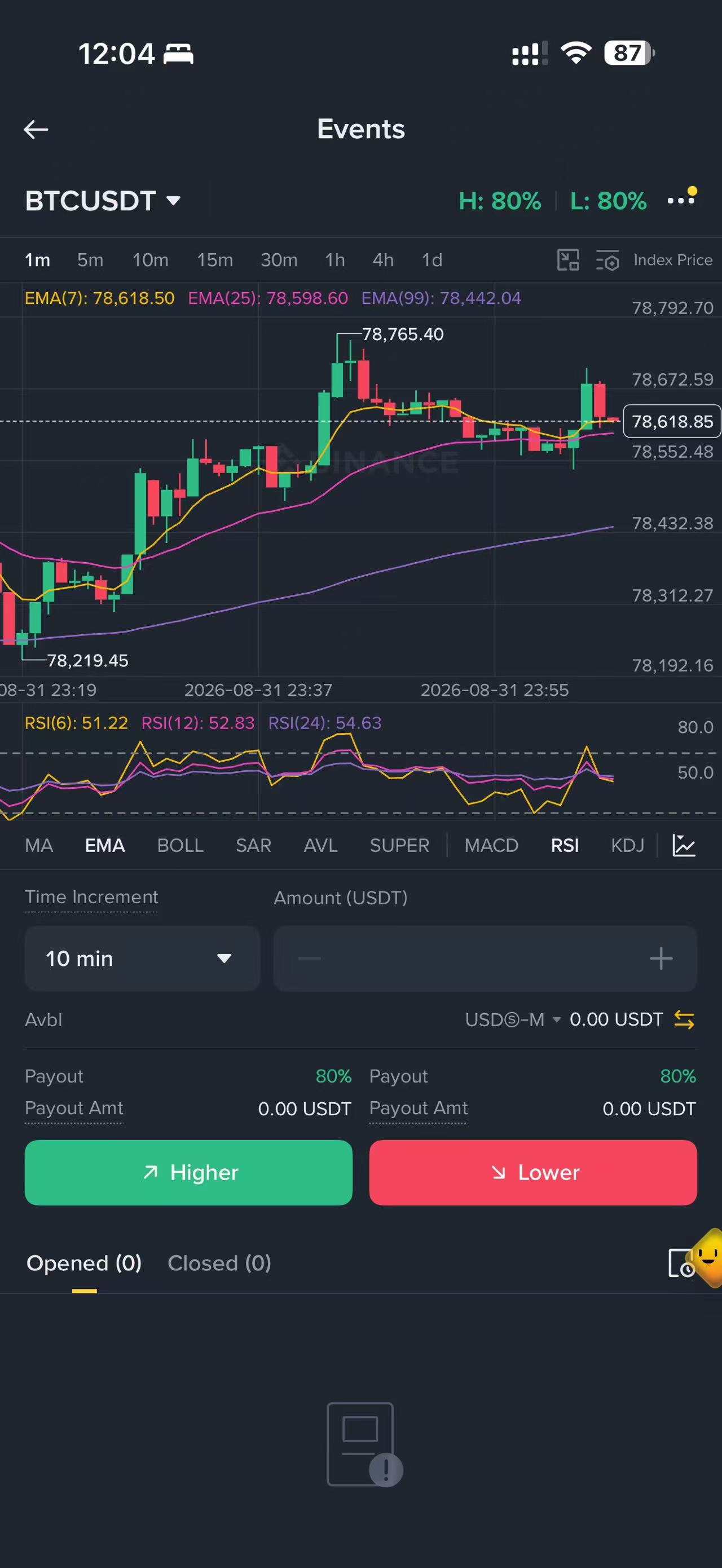
Payout: a September 1, 2026 production screenshot shows both Higher and Lower at 80% for the BTCUSDT ten-minute product, with both order panels again showing Payout 80%. The compared contract therefore uses r=0.80; after confirmation, its Potential Payout Amount is locked under the Binance Event Contracts Terms. A correct call returns A×1.8 in total and earns A×0.8 net. This proves 0.80 for both sides of the compared BTCUSDT ten-minute product without extrapolating it into a permanent constant for every asset and horizon.
Open: open time and open Price Index are set at the next second after placement. This is the comparison reference for that Higher/Lower trade, not a probability quoted by other users.
Settle: Higher wins when the expiry index is above the open index, Lower wins when below, and equality refunds Premium A. A wrong call returns 0 for a net loss of A; a correct call returns A×(1+r).
Long-run break-even (EV): let q be the unconditional win probability and t the tie probability. Long-run average P&L per Premium A is A×[0.8q−(1−q−t)], and the unconditional break-even threshold is q*=(1−t)/1.8. Conditional on a non-tie, the fixed hurdle is 1/1.8=55.56%. The Index Price feed checks opening and settlement values; it does not substitute for the payout ratio.
OKX: the sampled market lacked enough liquidity for a 100-share round trip
OKX held-to-resolution break-even is directly reproducible from public asks: q*=(buy notional+buy fee)/filled shares. Across the three synchronized snapshots, total cost to buy 100 Up shares was 94.902606, 94.810581, and 94.779744 USDT, giving break-even rates of 94.902606%, 94.810581%, and 94.779744%. On the Down side, only 80.5, 80, and 80 shares were available, so no 100-share break-even existed. More importantly, an Up purchase could immediately sell back only 80.5, 80, and 80 shares. The finding is insufficient visible liquidity in this market and sample window—not a product design that forbids entry or exit. Under the report's hard 100-share threshold, cost scores zero. This cannot be extrapolated to other OKX markets or long-run liquidity.
Why it reaches about 94.9%: this does not mean OKX predicts a 94.9% chance of winning; it is the liquidity-stress result of filling 100 shares immediately. After the buyer pays about 94.9 USDT, the true win probability must be about 94.9% merely to break even; a higher hurdle is worse for the buyer. The official instrument response gives face value ctVal=1 and lot size lotSz=0.1. In the first raw book, the first ten ask levels totaled only 1 share and 0.295 USDT of notional, followed by 40 shares at 0.90 and the remaining 59 shares at 0.99. Buy notional was therefore 0.295 + 40×0.90 + 59×0.99 = 94.705 USDT; adding the 0.197606 USDT taker fee gives 94.902606%. At a true 50% win probability, expected redemption is about 50 USDT and expected loss after entry cost is about 44.90 USDT—there is no buy-it-blind opportunity. The next two books likewise required 40 shares at 0.90 and 59 shares at 0.99. If a player uses a lower limit and refuses those 0.90 / 0.99 fills, the order does not reach 100 shares; that cannot justify substituting a lower “100-share break-even” figure.
Binance Wallet / Predict.fun example: 100 shares at P=0.50
Order: 100 shares have trade value 100×0.50=50 USDT. 0.50 is an order-book probability price, not a fixed net payout ratio.
Why the Up and Down buy quotes need not add to one: the two buttons show the immediately executable buy price for each side, not one midpoint probability split into complements. Predict records the Up (Yes) book: if its best bid is b and best ask is a, the immediate Up buy price is a, while the immediate Down buy price is 1−b, so they total 1+(a−b). The screenshot's Up 6¢ and Down 95¢ total 101¢, reflecting a 1¢ bid-ask spread rather than contradicting the $1 winning-share payout. Buying both sides also incurs fees and possible slippage. Only prices derived from the same complementary level, or the settlement face value of a complete Up + Down set, add to $1.
Taker fee: under the current official 200-bps formula, the fee is 0.02×min(0.5,0.5)×100=1 USDT, for total cost 51. In the current 5-minute rule, 100 shares on the selected side redeem 100 when closing and opening values differ; exact equality pays 0.50 per share to both sides. The strict break-even condition is therefore Pr(selected side wins)+0.5×Pr(tie)=51.00%; it simplifies to a 51% win rate only under a zero-tie assumption. The actual Wallet quote still controls filled shares, fees, and slippage.
Resting orders and exit: an unfilled limit order remains on the book; after a fill, shares may be sold before resolution, but price and full exit depend on live depth. Binance Wallet sponsors trading and settlement gas.
Starting from 50/50, how far each product mechanism lifts break-even
The first four order-book products use a common P=0.50, 100-share taker entry held to settlement, counting base taker fees only; Binance Event uses a net payout ratio of r=0.80. A nominally even directional call needs at least the win rate below to break even. This is not the live August 30, 2026 book. Spread, depth, and early-sale costs are calculated separately in the next section.
How far product mechanics lift the 50% break-even thresholdAxis shows percentage points above 50%; a longer bar means a harder break-even hurdle
+0+1.5+3.0+4.5+6.0 pp
Binance Wallet / Predict.fun51.00%
OKX51.125%
Polymarket51.75%
Kalshi51.75%
Binance Event · r=0.8055.56%
Binance Event calculation: a correct call earns 0.80 times the Premium and a wrong call loses the Premium, so non-tie break-even is 1÷(1+0.80)=55.56%. Exact index equality refunds the Premium and counts as neither a win nor a loss. Binance states that the payout ratio may change before placement and is fixed for that trade once confirmed. The first four exclude spread, depth slippage, rebates, discounts, and rewards.
Chart conclusion: the first four are order-book binary shares that permit early sale, and their standardized break-even rates cluster between 51.00% and 51.75%, a maximum gap of only 0.75 points. Base fees are not the main driver of the real trading experience. The decisive costs are the spread, book depth, and ability to complete an exit measured in section 3. Binance Event's 55.56% hurdle and lack of early exit make it the clear structural outlier.
3 · What an early exit costs: three live buy-then-sell checks
How a trader should read this: “round-trip loss” is how much is lost by buying 100 shares now and immediately selling all of them; lower is better. At 100 shares, 1 point equals 1 USDT / USD. It is not Path 1's potential profit; it is the trading drag a price move must first overcome.
Expand sample times and calculation method
Collection conditions:07:39:39, 07:40:32, and 07:41:20 UTC on August 30, 2026 (15:39:39, 15:40:32, and 15:41:20 Singapore time). Each round fetched all four venues within 2.6–3.3 seconds for the same 07:30–07:45 UTC BTC 15-minute window. For each venue and side, the calculation walks visible asks to buy 100 shares, then walks bids from that same snapshot to sell 100 shares. With six observations—three times × two sides—the median averages the two middle values. Because the three collections fall within 82 seconds, they are microstructure retests of one market window, not three independent market samples.
Polymarket
Median round-trip loss1.6013 pp
Cost score16.8 / 20
Kalshi
Median round-trip loss0.5665 pp
Cost score18.9 / 20
Wallet / Predict.fun
Median round-trip loss5.6620 pp
Cost score8.7 / 20
OKX
Sampled 100-share round trips0 / 6
Cost score0 / 20
Product
Complete round trips
Median spread
Median two-leg depth impact
Median two-leg fees
100-share immediate round-trip loss
Six-observation range
Kalshi
6 / 6
0.1000 pp
0.0000 pp
$0.4665
0.5665 pp
0.3002–1.2922 pp
Polymarket
6 / 6
1.0000 pp
0.0000 pp
$0.6013
1.6013 pp
1.3409–4.1591 pp
Binance Wallet / Predict.fun
6 / 6
3.0000 pp
2.6183 pp
0.372852 USDT
5.6620 pp
5.0648–5.9911 pp
OKX
0 / 6
15.9000 pp
No 100-share two-leg VWAP
Entry leg calculable; full pair N/A
Sampled 100-share round trip unfillable
Insufficient liquidity in that market at those times: Up break-even 94.779744%–94.902606%; exit only 80–80.5 shares
Binance Event
N/A
N/A
N/A
Officially no additional fee; this comparison calculates the payout discount using the compared contract's r=0.80
N/A
Closed and held to settlement; not an order-book liquidity-test subject
Buy 100 and hold: buyer's minimum break-even win rate (not a predicted probability)
This table is separate from immediate buy-then-sell loss. Its percentage uses executable entry prices and is the buyer's minimum true win rate after paying entry cost: higher means harder to break even, not that the platform predicts an easier win. Round-trip loss instead answers what an immediate exit costs. For the four order-book products, each value walks the same three public books to buy 100 shares and computes (buy notional+buy fee)/100. An order-book product has no platform-wide break-even rate independent of side and quote, so opposite sides are no longer blended into an approximately 50% median.
Product
100-share entries fillable
Three Up / Higher minimum win rates
Three Down / Lower minimum win rates
Player takeaway / strict convention
Polymarket
6 / 6
15.4199% / 5.3325% / 3.2037%
88.7392% / 96.2688% / 98.1372%
No platform-wide fixed rate; use the displayed threshold for that side and time
Kalshi
6 / 6
9.9074% / 3.7365% / 1.6035%
91.3848% / 96.8300% / 98.6967%
No platform-wide fixed rate; use the displayed threshold for that side and time
All three real Up thresholds exceed 94.77%; an ordinary player is highly likely to lose and should not place this immediate 100-share buy
Binance Event
Not share-based
55.56%
55.56%
Compared contract at r=0.80; the non-tie hurdle is 55.56%, and with ties the unconditional hurdle is q*=(1−t)/1.8
For order-book products that support early sale, total loss is buy notional + buy taker fee − sell notional + sell taker fee; at 100 shares, one dollar of loss equals one percentage point. Spread is best ask minus best bid, while depth impact is the additional two-sided VWAP loss beyond those top prices. If either leg cannot fill 100 shares, no price is invented: the observation is marked unfillable and cost scores zero. Binance Event offers no early sale, so it is not an unfillable order-book sample; this metric is not applicable (N/A). The aggregate evidence JSON binds three immutable source-response files containing the platforms' original HTTP/GraphQL bodies, response hashes, outcome mappings, market IDs, timestamps, and fee inputs. The verifier rebuilds books directly from those bodies and recalculates every figure.
Direct player meaning: at the same forecasting accuracy, Kalshi consumed the least of your edge in this sample, followed by Polymarket and then Wallet / Predict.fun. Their median 100-share immediate round-trip losses were 0.5665, 1.6013, and 5.6620 points. OKX was unfillable and cannot be inserted into that numerical sequence; Binance Event's immediate round-trip metric is N/A and is likewise excluded from this cost ranking. This is not a promise of long-run liquidity; it is the executable result for the stated size, window, and three synchronized collections. None of OKX's six side-observations could complete a 100-share immediate round trip; the constrained leg showed at most 80.5 visible shares.
Binance Event: the displayed odds are reproducible, but there is no immediate sale
Binance Event conclusion: it has no order book. The compared contract uses r=0.80, and its payout amount is locked at confirmation, so its non-tie break-even hurdle is 55.56%; with tie probability t, the unconditional hurdle is (1−t)/1.8. The public Index Price lets users check opening and expiry values. Mandatory hold-to-settlement is the product structure, not a liquidity defect, so immediate round-trip cost is N/A. The ranking records only the player-experience difference of having no self-pricing or early exit; the improvement appendix does not ask it to become an order-book product.
Maker rebates, referral discounts, rewards, deposit and withdrawal costs, onchain conversion, and FX costs are excluded. The simulation uses visible orders only, assumes no hidden liquidity, and does not attribute post-snapshot market movement to the immediate exit.
4 · How the ranking works: five trader priorities, 20 points each
Ranking conclusion: the four order-book products tie on price/exit controls, rule disclosure, and checkable settlement records. The ranking is driven mainly by executable liquidity in this sample; five-minute fit gives Polymarket only a four-point advantage over Kalshi. Cost comes from six live 100-share buy-then-sell checks: when all six fill, median loss R maps to max(0,20−2R); any incomplete exit scores zero. Binance Event has no order book, so cost is N/A. Mandatory hold-to-settlement is its product structure, not a defect to fix. It earns 0+20+20+16=56/80 on the other four dimensions, normalized to 70.
How applicable dimensions build each totalThe first four use 20 points per dimension; Binance Event excludes N/A cost and normalizes from 80
* Binance Event's three colored values are normalized contributions; raw scores are 20 for rule disclosure, 20 for checkable settlement records, 16 for short-horizon fit, zero for Pricing & Exit, and N/A for cost.
01 / 20Cost to buy and sell
All six exits must fill before applying max(0,20−2R); one incomplete exit means zero. Products with no early sale are N/A.
02 / 20Control price and early exit
Limit price, cancel unfilled orders, and sell positions: all three earn 20, two earn 13, one earns 7, none earns zero.
03 / 20Are fees and settlement rules clear?
Fees or payout discount, result source, tie or edge cases, and order/settlement-record rules earn five each.
04 / 20Can rules and settlement records be checked?
Outcome rule, result source, opening/closing values or equivalent result inputs, and account/onchain settlement record earn five each; lack of a historical-download endpoint is not mislabeled as an unverifiable result.
05 / 20Are sufficiently short markets available?
Five minutes or less=20; 15 minutes=16; 30 minutes=12; one hour=8; longer=4.
Rank / product
Cost threshold
Pricing & exit control
Rule transparency
Checkable rules & settlement records
Short-horizon fit
Total
① Polymarket
16.8/20
20/20
20/20
20/20
20/20
96.8/100
② Kalshi
18.9/20
20/20
20/20
20/20
16/20
94.9/100
③ Binance Wallet · Predict.fun
8.7/20
20/20
20/20
20/20
20/20
88.7/100
④ OKX
0/20
20/20
20/20
20/20
20/20
80/100
⑤ Binance Event
N/A (held to settlement)
0/20
20/20
20/20
16/20
56/80 × 100 = 70
Expand product-by-product scoring rationale
Polymarket · 96.8 — all six 100-share immediate round trips filled. Median loss was 1.6013 points, so cost is 20−2×1.6013=16.7974→16.8. Users can set prices, cancel, and sell early; fees, Chainlink TWAP values and timestamps, access to original signed reports, market rules, and final results are public, so the three related dimensions each score 20. Its 1.9-point lead over Kalshi comes from four more points for five-minute fit but 2.1 fewer points on sampled cost.
Kalshi · 94.9 — all six observations filled, with the lowest median 100-share immediate round-trip loss at 0.5665 points, for 20−2×0.5665=18.8670→18.9 on cost. The book provides full pricing and exit control, while market-specific rules, the BRTI result source, and settlement records are checkable. The verified crypto product was 15 minutes, scoring 16 for horizon and placing second overall.
Binance Wallet / Predict.fun · 88.7 — all six observations filled. Median 100-share immediate round-trip loss was 5.6620 points, for 20−2×5.6620=8.6760→8.7 on cost. Users can use market or limit orders, cancel, and sell early; the five-minute market uses signed Chainlink reports and onchain settlement. Its disclosed paused-state emergency path is fallback governance, not a defect to penalize without evidence of an actual settlement failure. Predict.fun is the venue and Binance supplies the Wallet gateway.
OKX · 80 — none of the six side-observations in the sampled market could complete a 100-share buy and sell against public depth; the constrained side showed at most 80.5 shares. This is a liquidity shortfall in that market and window, not a different product shape. The report does not invent a complete-loss number and awards zero for cost evidence. Median visible best bid-ask spread was 15.9 points across the six observations, making liquidity far more material than the base fee. Users can still set prices, cancel, and sell early; five-minute markets, rules, and settlement records are checkable, leaving 80 points across the other four dimensions.
Binance Event · 70 (normalized from 56/80) — the compared contract's r=0.80, next-second Price Index entry, expiry-index settlement, Premium refunds on equality, and order settlement records are checkable, so rules and records each score 20. Official terms make the Potential Payout Amount accepted at confirmation fixed for that contract; this report does not extrapolate 0.80 into a permanent platform-wide constant. Users cannot set prices or close early, so Pricing & Exit scores zero. Immediate round-trip cost is N/A because the product is designed to be held to settlement; this is neither double-penalized nor mislabeled as a defect. The four applicable dimensions total 56/80, normalized to 70, placing it fifth.
Appendix: sample-proven improvements, without treating product design as a defect
Conclusion: this section keeps only issues demonstrated by the sampled books or explicit rules and fixable within the existing product structure. Unsupported claims of missing receipts, already-public onchain settlement, no early exit on a fixed-payout product, and shorter horizons without compliance evidence are not listed as defects.
Product
Most serious problem → matching fix
Polymarket
Problem: Median immediate round-trip loss was 1.6013 USDT per 100 shares versus Kalshi's 0.5665; fix: lower short-horizon taker fees and reward tighter two-sided quotes.
Kalshi
Problem: only a 15-minute market was verified, so it does not fit players seeking five-minute markets; fix: clearly display the current minimum horizon by region rather than treating a five-minute launch as an automatic answer without compliance evidence.
Binance Wallet / Predict.fun
Problem: Among fillable products, median immediate round-trip loss was highest at 5.6620 USDT per 100 shares; fix: deepen both sides, narrow spreads, and lower taker fees.
OKX
Problem: None of six tests completed a 100-share round trip and median spread reached 15.9 points; fix: maintain at least 100 executable shares on both sides and publish compliance rates.
Binance Event
Problem: the compared contract's r=0.80 raises non-tie break-even to 55.56%, well above the roughly 51%–51.75% base-fee scenarios for the four order-book products; fix: increase the net payout ratio for such contracts to reduce the platform edge the player must overcome.
Appendix: ranking data and point-by-point calculation
Technical validation integrity is high: the verifier recalculates original-response hashes, market identity, side mapping, level-by-level fills, fee formulas, component scores, applicable-dimension denominators, totals, and charts. “High” describes data-chain and arithmetic integrity only. The rank answers the stated August 30, 2026 window, 100-share order, and disclosed equal-weight applicable-dimension rule; it is not extended into a long-run rank.
Rank / product
Current-book source and cost score
Other four dimensions
Total
① Polymarket
Gamma market metadata + two CLOB token books; three original-response rounds; R=1.6013 pp → 16.8
20+20+20+20=80
96.8
② Kalshi
Market and order-book APIs, ticker KXBTC15M-26AUG300345-45; three original-response rounds; R=0.5665 pp → 18.9
Public instrument + book APIs, BTC-UPDOWN-15MIN-260830-1530-1545; none of six side-observations completed 100 shares, so cost scores zero
20+20+20+20=80
80
⑤ Binance Event
The compared contract uses r=0.80, with its payout amount locked at confirmation; the non-tie hurdle is 55.56%, and including tie probability t it is (1−t)/1.8. Closed hold-to-settlement makes immediate round-trip cost N/A, not a zero liquidity score
0+20+20+16=56/80
70
Rank sensitivity: Polymarket leads Kalshi by only 1.9 points. With all other components fixed, Polymarket ties Kalshi if its median 100-share round-trip loss rises from 1.6013 to 2.5500 points. Holding the combined cost and short-horizon weight at 40, the exact tie is cost 26.229508 and short horizon 13.770492; Kalshi moves first only above 26.229508 on cost and below 13.770492 on short horizon. “Polymarket is first” therefore applies only to the disclosed equal-weight overall question; if the question is which venue eroded the least edge for an equally accurate player, the answer in this sample is Kalshi.
Falsification conditions: anyone can run the verifier against the preserved original responses. A market-ID mismatch, response-hash failure, unreproducible formula, or chart-table inconsistency fails validation. If more independent market windows change the cost medians, the entire report must be recalculated rather than retaining the old rank.
5 · Suitability and risk
First place is not a participation recommendation: without an after-cost edge demonstrated over a sufficient sample, ordinary players are not suited to any of these products, including overall leader Polymarket.
Planning to hold to expiry: first walk the book for the intended size and calculate q*=(buy notional+buy fee)/shares, then ask whether your true win rate can remain above it. All three real thresholds for the sampled OKX 100-share Up entry exceed 94.77%; an ordinary trader is extraordinarily unlikely to prove such stable accuracy and should not place that immediate order.
Planning to sell early: first check whether live bids can absorb the full position, then include the second fee, spread, and slippage. The three collections in section 3 prove executability only at those times, not all-day or long-run depth.
Choosing Binance Event: at r=0.80 for the compared contract, the non-tie break-even hurdle is 55.56%; with tie probability t, the unconditional hurdle is (1−t)/1.8. That contract's payout amount is locked at confirmation and must be held to expiry; 0.80 is not extrapolated into a permanent platform-wide constant.
More trades do not create an edge: frequent trading repeatedly pays spread, depth impact, or payout discount. When true accuracy does not clear all costs, more trades make losses more likely to converge.
No-real-money testnet experience: to learn direction selection, onchain confirmation, and expiry settlement without risking funds, use https://updown.bluffking.ai/. It runs on BNB Smart Chain testnet, where the test tokens have no value. BluffKing UpDown is operated by this report's publisher and is included only as an educational mechanism demo; it is not a ranked product and does not enter scoring, cost comparison, or ranking.
6 · Sources
Independence disclosure: this analysis uses no vendor-paid material, affiliate links, referral codes, vendor ranking inputs, or private discounts, and no ranked company participated in changing scores before publication. It relies only on official rules, public endpoints, and reproducible formulas; missing critical data is not filled with favorable assumptions.
Note: fees, payout ratios, market listings, settlement paths, regional access, and account eligibility may change. Order books and core product rules were checked on August 30, 2026; binary-options comparison sources were checked on August 31, 2026. Verify each market's rules and confirmation screen before trading.