Sangong
Bid for banker. Three cards decide.
Sangong for 2–6 players with friends or AI seats. Bid for banker, bet, then receive three cards. Each player faces the banker with server-dealt cards and separate practice chips.
- Players
- 2–6 players
- Ways to play
- Friend rooms · Play with bots
- Clubs
- Club rooms supported
- Chips & scoring
- Separate practice chips
- Category
- Card games
- Platforms
- Web · Telegram · iOS · Android
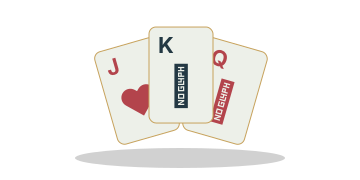
Fair play in Sangong, without exploitation
The server shuffles randomly and applies the room’s action and scoring rules. Membership tier is not an input to dealing. Per-game cryptographic verification records are not currently available for this game.
Fair play without exploitation: funded by memberships, not player losses. No manufactured hands or advantages for sale. Membership never changes the deal, rules, or outcome. No real-money play.
See fairness mechanisms and verification scope →Learn the basics. Then take a seat.
- 01
Bid blind: pass or 1–4×. Highest bid becomes banker; ties are random. If all pass, a random banker plays at 1×. Players bet 1–5×, then everyone receives three cards.
- 02
Big Sangong (three identical face ranks) > Small Sangong (three identical ranks A–10) > Mixed Sangong (three face cards) > 9 down to 0 points.
- 03
Each player compares with the banker. Transfer = base × banker bid × player bet × winning-hand multiplier: Big 9×, Small 7×, Mixed 5×, 8–9 points 3×, 0–7 points 1×.
Sangong · Rules and scoring
These are the rules used by BluffKing. Regional variants can differ; check the game settings before playing.
How results are settled
Net transfer = actual bet × winning-hand multiplier. Each player settles against the banker using the room’s configured payouts.
Playing rules
- One 52-card deck, no jokers, three cards each. A is 1; 2–9 use face value; 10/J/Q/K are zero. Only J/Q/K are face cards. Points are the sum modulo ten.
- Big Sangong (three identical face ranks) > Small Sangong (three identical ranks A–10) > Mixed Sangong (three face cards) > 9 down to 0 points.
- Equal points compare face-card count, then the highest card. Equal Sangong categories compare the highest card. Ranks: K down to A; suits: spades > hearts > clubs > diamonds.
- Bid blind: pass or 1–4×. Highest bid becomes banker; ties are random. If all pass, a random banker plays at 1×. Players bet 1–5×, then everyone receives three cards.
- Each player compares with the banker. Transfer = base × banker bid × player bet × winning-hand multiplier: Big 9×, Small 7×, Mixed 5×, 8–9 points 3×, 0–7 points 1×.
- Entry needs base × 9. Bid and bet limits reflect both banker and player funds to fully cover payouts. Zero-sum settlement, no rake. Leaving still settles the hand; insufficient balances sit out the next hand.
- Each phase lasts 15 seconds; defaults are pass, 1× bet and auto reveal. All hands become public together after everyone reveals. AI cannot read other players’ cards.
Before you play
BluffKing Sangong offers Three cards · Banker showdown. Sangong for 2–6 players with friends or AI seats. Bid for banker, bet, then receive three cards. Each player faces the banker with server-dealt cards and separate practice chips. Player count: 2–6 players. Friend rooms are available. Computer practice is also available. Start in a browser without downloading; this page describes BluffKing’s rules, not every regional variant.
One 52-card deck, no jokers, three cards each. A is 1; 2–9 use face value; 10/J/Q/K are zero. Only J/Q/K are face cards. Points are the sum modulo ten.
Equal points compare face-card count, then the highest card. Equal Sangong categories compare the highest card. Ranks: K down to A; suits: spades > hearts > clubs > diamonds.
Yes. Share the room code with friends and add AI to empty seats, or choose computer practice to start immediately.
Yes. Open BluffKing Sangong in a browser on Android, iPhone or a computer. Use this page’s Play button to open the game at https://app.bluffking.ai/games/sangong; no app installation is needed.
BluffKing Sangong friend rooms support 2–6 players. Create a human-player room in the game lobby and share its 4-digit room code. Friends open BluffKing, tap Join Game in the bottom navigation and enter the code; they do not need to choose a game first. You can also choose computer practice. See the game-specific rules and scoring on this page.
BluffKing Sangong is for practice and entertainment, with no real-money bets, deposits, cash prizes or cash-out. Scoring: Separate practice chips, with no monetary value. Membership does not change rules or outcomes.
Ready for Sangong?
Open the game and check its rules and scoring before starting.