Guandan
Also known as: Guan Dan, Throwing Eggs
Play Guandan online with friends or bots.
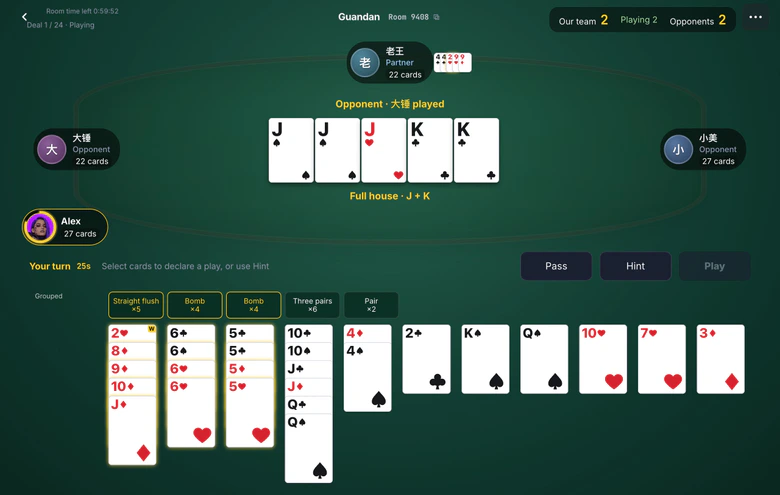
Guandan (Guan Dan) is a four-player partnership card game played with two decks. Opposite seats stay on the same team, with 27 cards each. Use heart-level wildcards, finish your hand and advance through levels together. Play in your browser with friends or bots, and learn combinations, tribute and passing Ace below.
- Players
- 4 players
- Ways to play
- Friend rooms · Play with bots
- Clubs
- Club rooms supported
- Chips & scoring
- Team levels and match results
- Category
- Team play
- Platforms
- Web · Telegram · iOS · Android
Fair play in Guandan, without exploitation
New deals use shared encrypted-deck, shuffle and decryption proofs with a fixed game-specific manifest: 36 cards for Short Deck, 52 for standard decks, jokers for Dou Dizhu, and distinct physical identities for Guandan and Color Clash. After completion, choose Verify dealing in the table menu for your proofs; Guandan provides each deal, while Color Clash chains discard reshuffle epochs. Only your permitted cards and public cards are opened; secret seeds are never published. The browser checks the proof against the commitment and visible cards saved on this device; missing visible-card observations are explicitly reported as incomplete verification. New deals lock the deck and seats before player commitment and reveal; each Guandan deal and Color Clash reshuffle has a fresh exchange. Full device verification requires your contribution and no withheld commitments; missing own contributions, withheld reveals or missing device evidence produce incomplete verification. Verification does not exclude operator aborts or prove every action, settlement rule or off-table behaviour. The server still knows the cards. Older deals keep their original verification protocol.
Fair play without exploitation: funded by memberships, not player losses. No manufactured hands or advantages for sale. Membership never changes the deal, rules, or outcome. No real-money play.
See fairness mechanisms and verification scope →Learn the basics. Then take a seat.
- 01
Each player gets 27 cards; opposite seats partner and play runs counterclockwise. Beat matching shapes, with bombs and straight flushes ranked by the rules.
- 02
Heart level cards can substitute for non-jokers in combinations. Choose a hand declaration when needed before playing.
- 03
The first finisher’s team advances according to the partner’s place, with tribute and returns when required. Start at level 2; passing A or reaching 24 deals ends the match.
Guandan · Rules and scoring
These are the rules used by BluffKing. Regional variants can differ; check the game settings before playing.
How results are settled
Results track team levels and the match outcome. The first finisher’s team advances according to their partner’s place. Passing A or reaching the deal limit determines the match result. Level gains and the passing-A condition are below; this game records levels and results only.
Playing rules
- Based on the trial Competitive Guandan Rules approved by the national board and card games administration, using round scoring and the online provisions below.
- Start at level 2 and play up to 24 deals. Passing A ends the match early; otherwise the higher level wins. Equal levels draw.
- Four players, two decks, 27 cards each. Opposite seats partner; play runs counterclockwise. Plays include singles, pairs, triples, full houses, five-card straights, three consecutive pairs, two consecutive triples, bombs, straight flushes and four jokers. A can be low in sequences; K-A-2 wrapping is invalid.
- Ranks: red joker, black joker, level rank, then A down to 2. Four jokers beat bombs of six or more cards, then straight flushes, five-card bombs, four-card bombs and ordinary plays. Equal-sized bombs compare rank; full houses compare the triple.
- Heart level cards substitute for non-jokers in combinations; alone they remain level cards. Choose a declaration after selecting cards. Sequences use natural rank. If a player finishes and everyone passes, their partner leads the next trick.
- Last place gives their highest non-wild card to first place. After a team takes first and second, both opponents give tribute; the higher card goes to first place, with ties assigned clockwise. Two red jokers held by the owing player or pair cancel tribute and first place leads. Otherwise, the donor to first place leads.
- Return a card no higher than 10; level cards rank above ordinary cards. If none qualify, return the lowest card. Double returns are revealed simultaneously after both recipients choose.
- The first finisher’s team advances 3, 2 or 1 levels when their partner finishes second, third or last. A must be played: the team playing A passes it by taking first place with its partner not last. There is no three-failures-reset rule.
- Online provisions: 30 seconds per action. Timeouts and disconnected seats use auto play. Matches pause when everyone is offline. Hints use only your hand and the public trick. Card counts are always shown. Leaving an active match hands your seat to auto play.
Before you play
Guandan is also known as Guan Dan or Throwing Eggs. BluffKing Guandan offers Partners · Wild cards, tribute and levels. Guandan (Guan Dan) is a four-player partnership card game played with two decks. Opposite seats stay on the same team, with 27 cards each. Use heart-level wildcards, finish your hand and advance through levels together. Play in your browser with friends or bots, and learn combinations, tribute and passing Ace below. Player count: 4 players. Friend rooms are available. Computer practice is also available. Start in a browser without downloading; this page describes BluffKing’s rules, not every regional variant.
Guandan (also written Guan Dan) is a four-player card game using two decks and fixed partnerships between opposite seats. Each player gets 27 cards. Beat the previous play with a higher matching combination, or a qualifying bomb or straight flush. The first finisher’s team gains levels based on the partner’s finishing place. This version starts at level 2 and ends when a team passes Ace or after 24 deals, with tribute and returns between deals when required. See the rules below for combinations and scoring.
This game records team levels and match results. The first finisher’s team advances according to the partner’s place; passing A or reaching the deal limit decides the match.
No. Heart level cards can represent non-jokers in combinations; when played alone, they remain level cards.
Last place gives the highest card other than a heart level card to first place. If one team takes the top two places, both opponents give tribute. Recipients return a card no higher than 10, with level cards above ordinary ranks; if none qualify, return the lowest card. Tribute is cancelled if the single owing player or the owing pair together hold both red jokers.
Gain 3 levels if the partner is second, 2 if third, and 1 if last. For example, a team at level 2 that takes first and third moves to level 4. Level A must actually be played: the team playing A must take first place with its partner not last to pass A.
Yes. Open Guandan in a phone or desktop browser without downloading an app. For friends, create a lobby room and share its four-digit code; they select Join Game and enter it, or join the same club room. The four seats form two teams of opposite partners. Computer opponents are also available for practice. Results track team levels and matches rather than chip wins.
Yes. Open BluffKing Guandan in a browser on Android, iPhone or a computer. Use this page’s Play button to open the game at https://app.bluffking.ai/games/guandan without installing an app.
BluffKing Guandan friend rooms support 4 players. Create a human-player room in the game lobby and share a link from Invite friends at the table, or its 4-digit room code. Friends open BluffKing, tap Join Game and enter the code; they do not need to choose a game first. Playing with other people requires an account; signed-out players register or sign in before returning to the invitation. You can also choose computer practice. See the game-specific rules and scoring on this page.
BluffKing Guandan lets you invite people you know into the same internet-connected room without using stranger matchmaking. Even when sitting together, each friend connects through their own device. This is not offline play, LAN-only multiplayer or a scorekeeper for a physical tabletop game. See this page’s friend-room answer for invitations; supported count: 4 players.
BluffKing Guandan is for practice and entertainment, with no real-money bets, deposits, cash prizes or cash-out. Scoring: Team levels and match results, with no monetary value. Membership does not change rules or outcomes.
Ready for Guandan?
Open the game and check its rules and scoring before starting.