Chinese Chess
Also known as: Xiangqi, Elephant Chess
Checkmate the other king — or leave it nowhere to go.
Red moves first and the two sides alternate. Checkmate wins, and a side with no legal move at all loses as well. The winner takes the stake from the loser, a draw settles nothing, and the colours swap for the next game.
- Players
- 2 players
- Ways to play
- Friend rooms · Play with bots
- Clubs
- Club rooms supported
- Chips & scoring
- Separate practice chips
- Category
- Board games
- Platforms
- Web · Telegram · iOS · Android
Fair play in Chinese Chess, without exploitation
Both players see the full board. The server validates moves, check and game endings. Both sides have the same per-move time limit and swap colours each game. Membership adds no clock time or rule advantages.
Fair play without exploitation: funded by memberships, not player losses. No manufactured hands or advantages for sale. Membership never changes the deal, rules, or outcome. No real-money play.
See fairness mechanisms and verification scope →Learn the basics. Then take a seat.
- 01
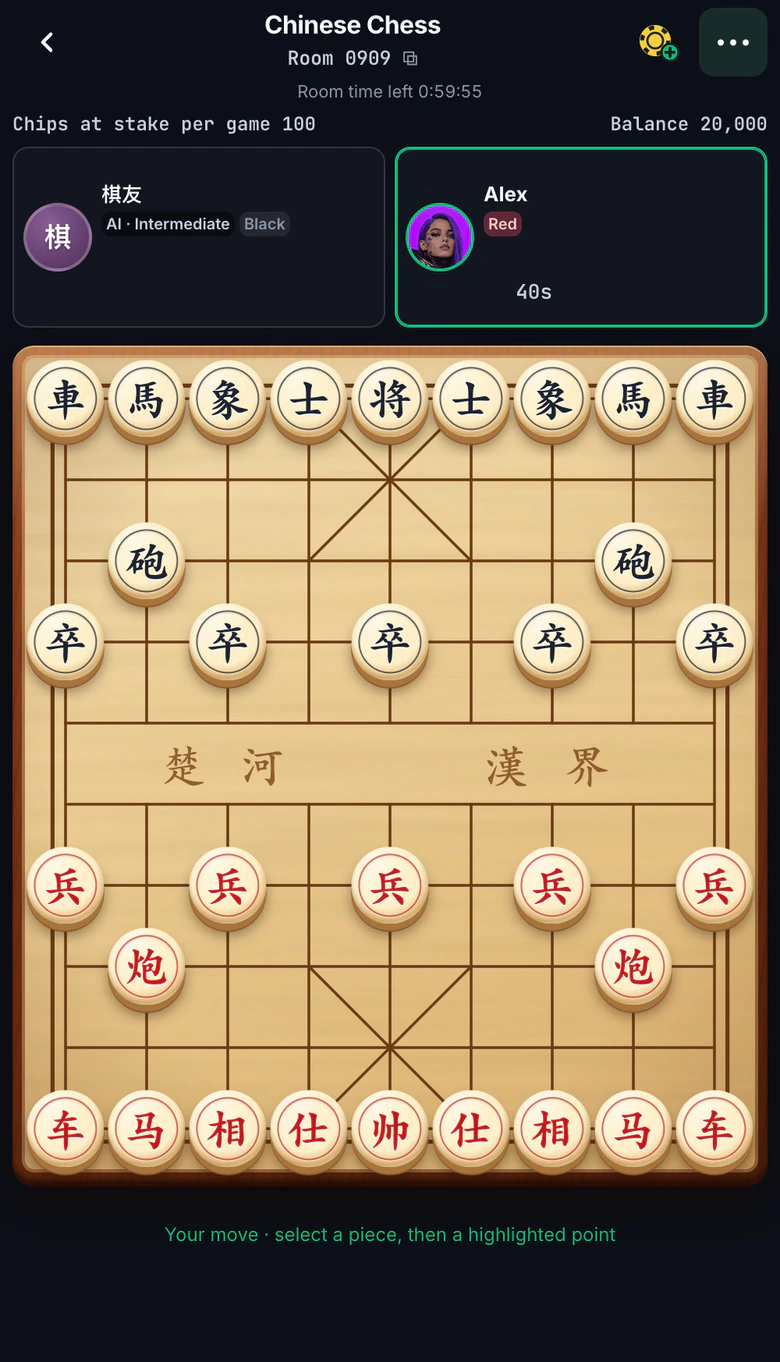
Nine files by ten ranks, split by the river. The king and advisors stay inside the palace, and elephants never cross.
- 02
A horse is blocked by a piece beside it, an elephant by the point it steps over, and a cannon captures only by jumping exactly one piece.
- 03
Checkmate or a total block decides it. Sixty full moves (120 individual moves) without a capture, a threefold repetition or an agreement is a draw, and perpetual check loses.
Chinese Chess · Rules and scoring
These are the rules used by BluffKing. Regional variants can differ; check the game settings before playing.
How results are settled
The winner of each game takes the stake from the loser; a draw settles nothing. Colours swap every game, and these practice chips are tracked separately from poker and the other games.
Playing rules
- Nine files by ten ranks, split by the river; the king and advisors stay inside the palace. Red moves first, then the two sides alternate.
- Tap one of your pieces to light up its legal destinations, then tap a destination or drag the piece there. Tap another of your pieces to switch.
- Checkmate wins. A side with no legal move at all also loses.
- The two kings may never face each other down an open file, so a move that exposes them is illegal.
- A draw follows 60 full moves (120 plies) without a capture, a threefold repetition, or when neither side has attacking material.
- A side that checks on every move of a repetition is perpetually checking and loses.
- Each move has 45 seconds; running out loses the game, and a disconnected seat gets a shorter clock so nobody waits for an empty chair.
- The winner takes the stake from the loser and a draw settles nothing. The next game starts when both players tap “Play again”, with colours swapped.
How each piece moves
- King: one orthogonal step, never leaving the palace.
- Advisor: one diagonal step, never leaving the palace.
- Elephant: two points diagonally, never across the river, and blocked if the midpoint is occupied.
- Horse: one step orthogonally then one diagonally, blocked if that first point is occupied.
- Rook: any distance along a line, never jumping a piece.
- Cannon: moves like a rook, but captures only by jumping exactly one piece.
- Pawn: one step forward, and once across the river also sideways — never backwards.
Before you play
Chinese Chess is also known as Xiangqi or Elephant Chess. BluffKing Chinese Chess offers Staked games · Colours swap · Three engine levels. Red moves first and the two sides alternate. Checkmate wins, and a side with no legal move at all loses as well. The winner takes the stake from the loser, a draw settles nothing, and the colours swap for the next game. Player count: 2 players. Friend rooms are available. Computer practice is also available. Start in a browser without downloading; this page describes BluffKing’s rules, not every regional variant.
Yes. BluffKing Chinese Chess offers two-player friend rooms and computer practice. Red moves first and colors switch next game. Checkmate and stalemate both lose; perpetual check and repeated positions follow this page’s rules. The winner receives one room stake from the loser, while draws have no settlement. Practice chips have no monetary value.
When the same position appears three times, a side that gave check on every one of its moves in between loses; otherwise the repetition is a draw.
The stake chosen for the table: the winner takes one stake from the loser, and a draw leaves both balances unchanged. Chips are for practice and have no monetary value.
A side with no legal move loses in BluffKing Chinese Chess, even when its king is not currently in check. If your opponent has no legal move, you win the game and receive one room stake in practice chips.
Yes. Open BluffKing Chinese Chess in a browser on Android, iPhone or a computer. Use this page’s Play button to open the game at https://app.bluffking.ai/games/xiangqi without installing an app.
BluffKing Chinese Chess friend rooms support 2 players. Create a human-player room in the game lobby and share a link from Invite friends at the table, or its 4-digit room code. Friends open BluffKing, tap Join Game and enter the code; they do not need to choose a game first. Playing with other people requires an account; signed-out players register or sign in before returning to the invitation. You can also choose computer practice. See the game-specific rules and scoring on this page.
BluffKing Chinese Chess lets you invite people you know into the same internet-connected room without using stranger matchmaking. Even when sitting together, each friend connects through their own device. This is not offline play, LAN-only multiplayer or a scorekeeper for a physical tabletop game. See this page’s friend-room answer for invitations; supported count: 2 players.
BluffKing Chinese Chess is for practice and entertainment, with no real-money bets, deposits, cash prizes or cash-out. Scoring: Separate practice chips, with no monetary value. Membership does not change rules or outcomes.
Ready for Chinese Chess?
Open the game and check its rules and scoring before starting.