Xiangyang Ka Wu Xing
Also known as: Kawuxing, Ka Wu Xing
A table built around Xiangyang rules.
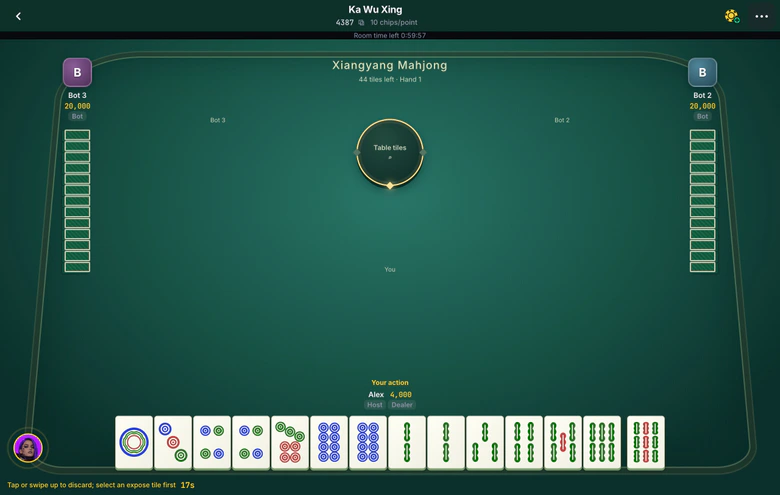
Play with 84 tiles: dots, bamboo and dragons. Decide when to pung, kong, wait or expose a ready hand, with separate explanations for winning patterns, kong payments and settlement.
- Players
- 2–3 players
- Ways to play
- Friend rooms · Play with bots
- Clubs
- Club rooms supported
- Chips & scoring
- Separate practice chips
- Category
- Mahjong
- Platforms
- Web · Telegram · iOS · Android
Fair play in Xiangyang Ka Wu Xing, without exploitation
The server shuffles randomly and applies the room’s action and scoring rules. Membership tier is not an input to dealing. Per-game cryptographic verification records are not currently available for this game.
Fair play without exploitation: funded by memberships, not player losses. No manufactured hands or advantages for sale. Membership never changes the deal, rules, or outcome. No real-money play.
See fairness mechanisms and verification scope →Learn the basics. Then take a seat.
- 01
Three players use dots, bamboo and dragons, four copies each. Any pair can be eyes. Pung and kong are allowed; chow is not.
- 02
Draw and discard, choosing legal pung, kong, exposure or win actions. Five-wait and other hand patterns follow this room’s rules.
- 03
Wins settle using the base and hand multiplier, with exposure and liability rules applied. Kong payments settle separately and remain after a drawn hand.
Xiangyang Ka Wu Xing · Rules and scoring
These are the rules used by BluffKing. Regional variants can differ; check the game settings before playing.
How results are settled
Chip transfers use chips per point × hand multiplier, then exposure and discard liability apply. Both opponents pay a self-draw; the discarder pays a discard win. Kong transfers settle separately and survive draws. Caps, exposure, draw payments and the hand table are below. Practice chips are tracked separately.
Playing rules
- 3 players and 84 tiles: dots, bamboo and dragons, four of each. Any pair may be eyes. Pung and kong are allowed; chow is not.
- Plain hands can self-draw. A discard win needs at least 2×, or either the winner or discarder must have exposed their listening hand. Five-wait requires the winning five-dot or five-bamboo to complete a 4–5–6 sequence.
- Compatible patterns multiply; use the highest valid combination. Normally capped at 8×, or 16× for double dragon pairs. Seven pairs does not combine with five-wait or four-return-one.
- When listening, you may expose only the listening fragment and waits; completed groups stay concealed. Autoplay then takes a legal win or discards the drawn tile, without pung or kong. Each exposed player’s wins and losses multiply by 2 after the hand-type cap. A discard into an exposed hand pays both opponents’ shares.
- Exposed kong: the discarder pays 2×. Added kong: each opponent pays 1×. Concealed kong: each pays 2×. Kong chips settle immediately, ignore exposure multipliers and survive draws. A robbed added kong earns no kong payment.
- If the wall runs out without a winner, each exposed player pays each unexposed player 1×. The winner deals next; with two discard winners, the discarder deals. A drawn hand keeps the dealer unless exactly one player exposed, in which case that player deals.
- Hu takes priority over pung and kong; two players may win the same discard. Only added kongs can be robbed. Passing a win blocks further discard wins until your next draw. The final tile can win, but cannot be punged or konged.
- Each action allows 20 seconds before autoplay. Disconnected players keep their seats and can reconnect to resume.
- Horse bonuses, fixed piao, wild tiles and consecutive-kong doubling are selected when creating the room. Check the room’s options.
| Pattern | Multiplier |
|---|---|
| Plain hand | ×1 |
| All triplets | ×2 |
| Five-wait | ×2 |
| Exposed four-return-one | ×2 |
| Concealed four-return-one | ×4 |
| Pure suit | ×4 |
| Seven pairs | ×4 |
| Dragon seven pairs | ×8 |
| Double dragon seven pairs | ×16 |
| Big three dragons | ×8 |
| Small three dragons | ×4 |
| Single tile in hand | ×4 |
| Kong self-draw | ×2 |
| Kong discard win | ×2 |
| Robbed kong | ×2 |
| Last-tile self-draw | ×2 |
Before you play
Xiangyang Ka Wu Xing is also known as Kawuxing or Ka Wu Xing. BluffKing Xiangyang Ka Wu Xing offers Three-player mahjong · Xiangyang base rules. Play with 84 tiles: dots, bamboo and dragons. Decide when to pung, kong, wait or expose a ready hand, with separate explanations for winning patterns, kong payments and settlement. Player count: 2–3 players. Friend rooms are available. Computer practice is also available. Start in a browser without downloading; this page describes BluffKing’s rules, not every regional variant.
Yes. BluffKing Xiangyang Ka Wu Xing uses 84 tiles for 2–3 players, with pung, kong, ready hands and exposed-ready play, but no chow. Room settings include horses, fixed piao, red-dragon wildcards and consecutive-kong doubling, with classic Xiangyang defaults. Two people can start, or add computers. Consult this page for the exact regional rules.
Choose horse bonuses, fixed piao, red-dragon wild tiles and consecutive-kong doubling when creating a room. Xiangyang classic defaults to no horse, no piao, no wild tiles and kong-chain doubling on. See the pattern table and caps on this page.
Yes. Two live players are enough to deal. A third player can take the open seat between hands, or the host can add a computer opponent.
All-human hands are monitored automatically for coordinated play. Confirmed pairs are temporarily suspended from Ka Wu Xing games; practice against computer opponents is unaffected.
No chow is allowed; pung and kong follow the rules. Its three-player, 84-tile structure differs from standard four-player mahjong.
Yes. The ordinary hand multiplier is capped at 8 before exposure is applied. With base 10 and a capped 8× hand, an exposed winner who self-draws against two unexposed opponents receives 10 × 8 × 2 = 160 from each, or 320 total, assuming no kong payments. Kongs settle separately; double dragon pairs have a 16× hand cap.
Yes. Open BluffKing Xiangyang Ka Wu Xing in a browser on Android, iPhone or a computer. Use this page’s Play button to open the game at https://app.bluffking.ai/games/kwx without installing an app.
BluffKing Xiangyang Ka Wu Xing friend rooms support 2–3 players. Create a human-player room in the game lobby and share a link from Invite friends at the table, or its 4-digit room code. Friends open BluffKing, tap Join Game and enter the code; they do not need to choose a game first. Playing with other people requires an account; signed-out players register or sign in before returning to the invitation. You can also choose computer practice. See the game-specific rules and scoring on this page.
BluffKing Xiangyang Ka Wu Xing lets you invite people you know into the same internet-connected room without using stranger matchmaking. Even when sitting together, each friend connects through their own device. This is not offline play, LAN-only multiplayer or a scorekeeper for a physical tabletop game. See this page’s friend-room answer for invitations; supported count: 2–3 players.
BluffKing Xiangyang Ka Wu Xing is for practice and entertainment, with no real-money bets, deposits, cash prizes or cash-out. Scoring: Separate practice chips, with no monetary value. Membership does not change rules or outcomes.
Ready for Xiangyang Ka Wu Xing?
Open the game and check its rules and scoring before starting.
Looking for games like Xiangyang Ka Wu Xing? Compare play styles →