Dou Dizhu
Also known as: Doudizhu, Fight the Landlord
One landlord. Two farmers working together.
Bidding decides your role; your plays set the pace. Race to finish as landlord, or coordinate with the other farmer so either teammate goes out first. Try bots without registering, with your last lobby settings remembered. Playing with other people requires an account.
- Players
- 3 players
- Ways to play
- Friend rooms · Play with bots
- Clubs
- Club rooms supported
- Chips & scoring
- Separate practice chips
- Category
- Card games
- Platforms
- Web · Telegram · iOS · Android
Fair play in Dou Dizhu, without exploitation
New deals use shared encrypted-deck, shuffle and decryption proofs with a fixed game-specific manifest: 36 cards for Short Deck, 52 for standard decks, jokers for Dou Dizhu, and distinct physical identities for Guandan and Color Clash. After completion, choose Verify dealing in the table menu for your proofs; Guandan provides each deal, while Color Clash chains discard reshuffle epochs. Only your permitted cards and public cards are opened; secret seeds are never published. The browser checks the proof against the commitment and visible cards saved on this device; missing visible-card observations are explicitly reported as incomplete verification. New deals lock the deck and seats before player commitment and reveal; each Guandan deal and Color Clash reshuffle has a fresh exchange. Full device verification requires your contribution and no withheld commitments; missing own contributions, withheld reveals or missing device evidence produce incomplete verification. Verification does not exclude operator aborts or prove every action, settlement rule or off-table behaviour. The server still knows the cards. Older deals keep their original verification protocol.
Fair play without exploitation: funded by memberships, not player losses. No manufactured hands or advantages for sale. Membership never changes the deal, rules, or outcome. No real-money play.
See fairness mechanisms and verification scope →Learn the basics. Then take a seat.
- 01
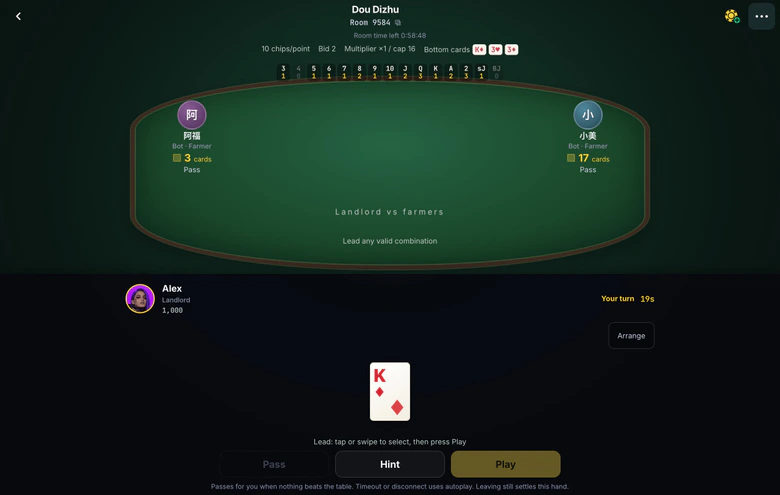
Three players use a 54-card deck, with 17 cards each. Bid 1, 2 or 3, or pass; the landlord takes the three remaining cards.
- 02
The landlord leads. Beat the previous play with a higher matching shape or pass. Two passes let the last player lead again.
- 03
The landlord wins by going out first; either farmer going out wins for both. Bombs, rockets and springs affect the settlement multiplier.
Dou Dizhu · Rules and scoring
These are the rules used by BluffKing. Regional variants can differ; check the game settings before playing.
How results are settled
Each farmer settles chips per point × bid × multiplier; the landlord settles the combined result of both farmers. Bombs, rockets and springs affect the multiplier; see the cap below. Practice chips are tracked separately from other games.
Playing rules
- Three players use 54 cards: 17 each plus 3 bottom cards for the landlord, who leads. Either farmer going out wins for both farmers.
- Bid 1, 2 or 3 above the current bid, or pass. A bid of 3 ends bidding. If all pass, redeal.
- Play singles, pairs, triples, triples with a single/pair, straights, pair runs, planes with wings, four with two, bombs and rockets. Straights need 5 ranks, pair runs 3 pairs; runs exclude 2s and jokers.
- Beat the same shape and length with a higher main rank. Bombs beat ordinary shapes; the rocket beats all. Two passes clear the trick and the last player leads; the leader cannot pass.
- Single plane wings may form pairs but cannot use a fourth card of a body rank. Pair wings must be distinct pairs. Four with two singles may carry a pair; four with two pairs needs distinct pairs.
- Each farmer wins or loses chips per point × bid × multiplier; the landlord settles the combined result of both farmers. Bombs, rocket and spring double the multiplier, capped at 16. Spring: landlord wins before either farmer plays; reverse spring: farmers win after the landlord plays only once.
- Each session starts with a free chip buy-in. Add chips during the session; chips cannot be redeemed for cash. Entry needs one point’s worth of chips; actual wins and losses are capped by both sides’ opening chips. Timeout or disconnect uses autoplay; leaving still settles the current hand.
Before you play
Dou Dizhu is also known as Doudizhu or Fight the Landlord. BluffKing Dou Dizhu offers One deck · Landlord versus farmers. Bidding decides your role; your plays set the pace. Race to finish as landlord, or coordinate with the other farmer so either teammate goes out first. Try bots without registering, with your last lobby settings remembered. Playing with other people requires an account. Player count: 3 players. Friend rooms are available. Computer practice is also available. Start in a browser without downloading; this page describes BluffKing’s rules, not every regional variant.
Yes. BluffKing Dou Dizhu has exactly three players. Bidding decides the landlord; the other two are farmers. The landlord wins by finishing first, while either farmer finishing first wins for both farmers. Friend rooms and no-sign-up computer practice are available. It uses practice chips; see this page for scoring and bomb multipliers.
No. Either farmer going out first wins the hand for both farmers.
Each farmer settles base × bid × multiplier; the landlord settles both farmers’ combined result. The doubling multiplier is capped at 16. Full rules and an example are on this page.
For base 10, bid 3 and exactly one bomb with no other doubling, the multiplier is 2. Each farmer settles 10 × 3 × 2 = 60; the landlord settles 120. If the landlord goes out first, the landlord wins 120. If either farmer goes out first, each farmer wins 60.
Yes. Open BluffKing Dou Dizhu in a browser on Android, iPhone or a computer. Use this page’s Play button to open the game at https://app.bluffking.ai/games/ddz without installing an app.
BluffKing Dou Dizhu friend rooms support 3 players. Create a human-player room in the game lobby and share a link from Invite friends at the table, or its 4-digit room code. Friends open BluffKing, tap Join Game and enter the code; they do not need to choose a game first. Playing with other people requires an account; signed-out players register or sign in before returning to the invitation. You can also choose computer practice. See the game-specific rules and scoring on this page.
BluffKing Dou Dizhu lets you invite people you know into the same internet-connected room without using stranger matchmaking. Even when sitting together, each friend connects through their own device. This is not offline play, LAN-only multiplayer or a scorekeeper for a physical tabletop game. See this page’s friend-room answer for invitations; supported count: 3 players.
BluffKing Dou Dizhu is for practice and entertainment, with no real-money bets, deposits, cash prizes or cash-out. Scoring: Separate practice chips, with no monetary value. Membership does not change rules or outcomes.
Ready for Dou Dizhu?
Open the game and check its rules and scoring before starting.